Seminars
12 May 2026
,
16:00
-
17:00
| Download
Calendar Event (ICS)
Anna Nussbaum Auditorium and online,
Hallerstrasse 6, Bern, Switzerland
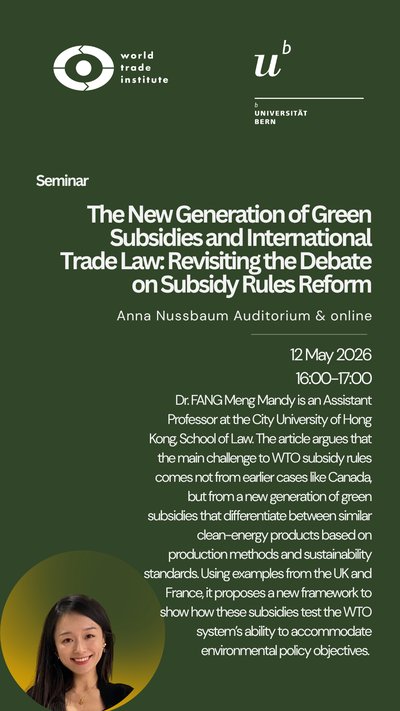
The New Generation of Green Subsidies and International Trade Law: Revisiting the Debate on Subsidy Rules Reform
The debate over reforming the World Trade Organization (WTO) subsidy rules under the Agreement on Subsidies and Countervailing Measures (ASCM) has been ongoing, particularly since the trade dispute initiated by the European Union and Japan challenging Canada’s feed-in tariffs (FITs). Concerns have centered on the notion that current multilateral trade rules offer insufficient policy space for WTO members to deploy subsidies, such as FITs, to support the clean energy transition, thereby creating a pressing need for reform. While this article acknowledges the importance of revising the WTO subsidy rules, it challenges the validity of these concerns as primarily derived from the Canada case. Instead, it argues that the real test for WTO subsidy rules stems from a new generation of green subsidies that differentiate within the same clean energy technology group based on products’ processes and production methods, conditioning eligibility on meeting predefined sustainability standards. Drawing on examples from the United Kingdom’s Electric Car Grant and France’s Ecological Bonus Scheme, this article introduces and applies a new conceptual framework for understanding the emergence and evolution of these green subsidies and the corresponding challenges to the WTO framework’s capacity to accommodate environmental objectives. It advocates for WTO reform by adopting a carefully calibrated balancing approach tailored to the nuanced design and implementation of this new generation of green subsidies. This reform would enable members to deploy these subsidies without undue constraint, while strengthening the WTO’s capacity to align trade liberalization with the imperatives of the green transition.
About the speaker
Dr. FANG Meng Mandy is an Assistant Professor at the City University of Hong Kong, School of Law. Her research interests focus on the interface between international trade, environmental protection, and energy transition. Her publications appear in journals such as the Virginia Journal of International Law, Leiden Journal of International Law, World Trade Review, Vanderbilt Journal of Transnational Law, Utilities Policy, and edited books published by Cambridge University Press, among others. Her research project on China’s environmental governance of plastic pollution received competitive funding from the Hong Kong Government, Research Grant Council for a duration of 24 months. She was awarded the Richard M. Buxbaum Prize for Teaching in Comparative Law by the American Society of Comparative Law in 2023.