
2 Mar 2026
Governing the Global Digital Economy
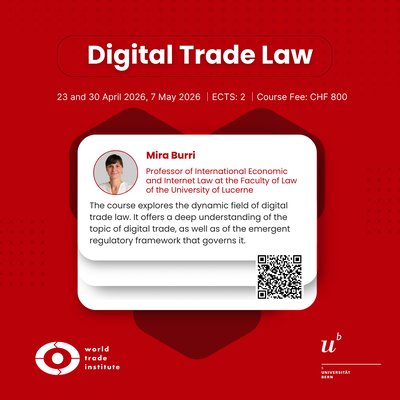
Learn the latest of Digital Trade Law with Professor Mira Burri, Professor of International Economic and Internet Law at the Faculty of Law of the University of Lucerne
How are the rules of the global digital economy made? Who decides how data moves across borders? And how do trade law, privacy, artificial intelligence, and sustainability intersect in shaping our digital future?
This course takes you inside the rapidly evolving world of digital trade law — one of the most dynamic and contested areas of international economic governance today.
You will explore how the World Trade Organization (WTO) regulates digital commerce and examine the cutting-edge plurilateral negotiations under the Joint Initiative on E-Commerce. At the same time, you will analyze the detailed digital trade chapters of major trade agreements such as the Comprehensive and Progressive Agreement for Trans-Pacific Partnership (CPTPP), the United States–Mexico–Canada Agreement (USMCA), and the EU–UK Trade and Cooperation Agreement — agreements that are actively shaping global regulatory standards.
Beyond traditional trade rules, the course introduces the emerging model of Digital Economy Agreements (DEAs), examining how states are experimenting with new forms of cooperation in a technologically fast-moving environment.
Importantly, this course does not treat digital trade as a purely technical subject. You will critically engage with some of the most pressing policy debates of our time:
-
Data governance and cross-border data flows
-
Privacy and fundamental rights
-
Artificial intelligence regulation
-
Digital trade and sustainability
-
Development, inequality, and the Global South
By the end of the course, you will understand not only the legal architecture of digital trade governance but also the political economy behind it — including how key global actors position themselves in negotiations and how power, technology, and law intersect.
This course is ideal for students interested in international law, trade policy, technology regulation, global governance, or the future of the digital economy.
This course takes you inside the rapidly evolving world of digital trade law — one of the most dynamic and contested areas of international economic governance today.