

2 Mar 2026
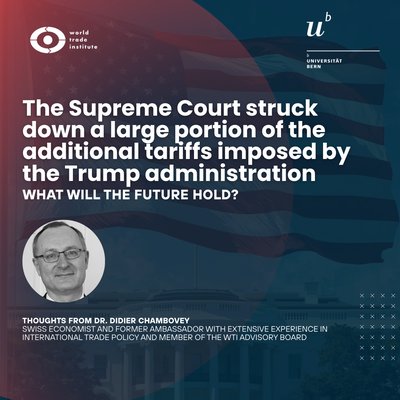
The Supreme Court struck down a large portion of the additional tariffs imposed by the Trump administration: What will the future hold?
Recent Developments in U.S. Tariff Policy: A Summary Analysis
In February 2026, the U.S. Supreme Court delivered a landmark ruling by invalidating the tariffs imposed under the International Emergency Economic Powers Act (IEEPA). The Court held that IEEPA does not grant the President authority to impose customs duties without explicit authorisation from Congress, striking down tariffs covering roughly one-quarter of U.S. imports and reaffirming the constitutional separation of powers.
While this decision nullified a core pillar of the previous tariff framework, it did not affect levies based on other statutes, such as Section 232 (national security) and Section 301 (unfair trade practices), which together still cover a meaningful share of imports. The Court left unresolved the question of reimbursement for duties already collected, meaning importers seeking refunds may face a prolonged and complex legal process.
150 days to attempt reproducing the previous tariff regime on a more secure basis
To replace the IEEPA tariffs, President Trump swiftly imposed a 10% global surcharge under Section 122 of the Trade Act of 1974, a never used provision meant for major balance‑of‑payments problems. Surcharges can only be kept in place for 150 days unless Congress extends the measure. They are added directly to current Most Favoured Nation (MFN) duties. Most existing exemptions were retained. Days later, the President said he planned to raise the surcharge to 15%, the legal maximum. However, the administration has not yet issued the order needed to apply the higher rate, and officials say the 15% tariff is still “being worked on.”
Many experts consider that this provision does not apply in a floating exchange rate regime as long as the United States does not risk losing access to financial markets. It is therefore likely that this decision will be challenged in court. But as its duration is limited to 150 days, the relevant jurisdictions will probably not have time to reach a ruling.
This stopgap mechanism gives the Executive Branch limited time to explore more durable legal foundations for tariffs, including through Sections 301 and 232 that could lead to tariffs grouped by country, trade issue, or sector.
Political resistance to the President’s authority to impose tariffs at will?
Political resistance to broad tariff authority persists, even within the President’s own party, and with midterm elections approaching, policymakers appear to be concerned about the economic costs’ tariffs impose on businesses and consumers. The President probably does not have a congressional majority willing to grant him the authority to impose, modify, or repeal tariffs at will, as he did under the IEEPA.
The current manoeuvre thus represents a transitional phase: stabilising tariff coverage in the short run while laying the groundwork for future measures that are legally and politically sustainable.
In principle, the new instruments are less flexible and more limited in scope. Section 301, used against China during the first term, requires identifying countries and unfair trade practices. Section 232, used e.g. for steel, aluminium, and copper, targets products whose importation threatens national security.
Both options require prior investigations. However, past experience has shown, that they allowed the President to impose broad-based tariffs without consulting Congress. Accelerated work on new investigations signals continuing volatility in the global trade environment.
A potentially new tariff landscape with similar policy objectives
The question now is whether the former tariff structure - on which trade agreements concluded by Washington since 2025 are based - will be restored, or whether the new tariffs will reshape the landscape. The European Union has suspended work on implementing its trade agreement with the United States pending clarification of the new treatment.
The administration is expected to pursue three overarching objectives: (i) maintaining sustained pressure on trading partners to ensure that they honour the commitments set out in the agreements negotiated with the United States; (ii) continuing to supply the federal budget through customs revenues; and (iii) preserving sufficient room for manoeuvre to respond to unforeseen developments or to counter certain foreign policy initiatives, such as the European Union’s environmental and digital regulatory frameworks.
About the author
Didier Chambovey is a Swiss economist and former ambassador with extensive experience in international trade policy. He served as Head of the Swiss Mission to the World Trade Organization (WTO) and to European Free Trade Association and was a senior trade negotiator for the Swiss Federal Government, chairing both the WTO General Council and the Organisation for Economic Co-operation and Development Trade Committee. He holds a PhD in economics from the University of Lausanne and currently serves on the Advisory Board of the World Trade Institute at the University of Bern, where he continues to contribute to research and analysis on global trade governance.
The President probably does not have a congressional majority willing to grant him the authority to impose, modify, or repeal tariffs at will, as he did under the IEEPA.
— Former Ambassador Dr. Didier Chambovey