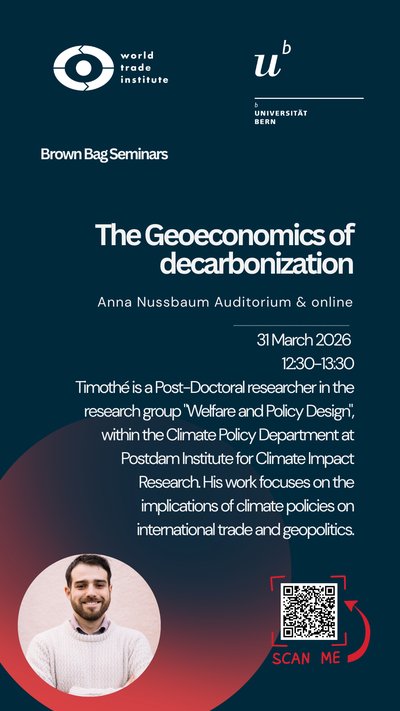
Brown Bag Seminar
31 Mar 2026
,
12:30
-
13:30
| Download
Calendar Event (ICS)
Anna Nussbaum Auditorium and online,
Hallerstrasse 6, Bern, Switzerland
The Geoeconomics of decarbonization
In the context of the spectacular weakening of international institutions, increasing weaponization of trade interrelations and the erosion of the international consensus underpinning the Paris agreement, climate policies solely building on the common good and reciprocal efforts seem unlikely to succeed. Instead, this seminar will discuss how climate mitigation can be framed in the coordinates of geoeconomics. First, a working paper on "geopolitical externality of climate policy", will be introduced which argues that the reduction of fossil fuel demand due to climate policies can generate security dividends by limiting the resources available to build military capacity in fuel-exporting countries. In the context of the Russian war in Ukraine, it estimate that each Euro of oil use reduction in the EU reduces the fiscal effort to support Ukraine by 32 cents, which justifies in itself a carbon price above 50 Euros per ton of CO2. Second, the presentation will discuss the "coalition-building potential of the EU CBAM" to illustrate the strategic leverage that climate policies with trade implications create. In this paper, the authors combine a quantitative trade model with a game theory module to evaluate the potential of the EU CBAM to trigger the formation of a de facto climate club. They show that the potential of the EU CBAM to trigger the adoption of carbon pricing in other countries largely exceed its direct, anti-leakage effect. Based on these two arguments, the author will argue that the erosion of multilateralism challenges the traditional structure of international cooperation but provides new motives and opportunities for unilateral decarbonization.
About the speaker
Timothé Beaufils is a Post-Doctoral researcher in the research group "Welfare and Policy Design", within the Climate Policy Department at Postdam Institute for Climate Impact Research. His work focuses on the implications of climate policies on international trade and geopolitics.
In his research he combines Multi-Regional Input Output analysis, New Quantitative Trade Models and game theory to evaluate the potential impacts of the EU Carbon Border Adjustment Mechanism on climate cooperation.
Broadly, he is interested in how climate policies interact with international relations, geopolitics and industrial policies.
He was trained as an Engineer, with a specialization in Energy Systems and received a Master's in Environmental Economics in 2019 and PhD in 2023 from the Postdam Institute as well.
See more about the Potsdam Institute for Climate Impact Research