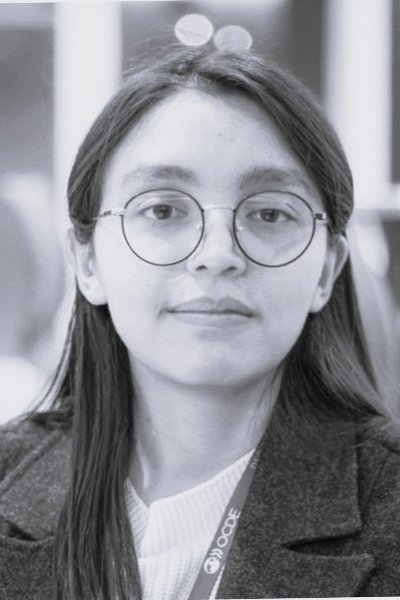
Maria Alejandra González Pinto
World Trade Institute
Maria Alejandra is from Fusagasugá, Colombia, and holds a Bachelor’s of Law (LL.B) from the Universidad Externado de Colombia. Her interest in the Asia–Pacific region led her to pursue a Master of Laws (LL.M) in Asian Economic Integration and Law at Waseda University in Japan, where she developed a deeper understanding of different approaches to economic integration and the legal and economic issues underpinning it. Her research focused on cross-border data flow frameworks under three integration schemes: the Pacific Alliance, the CPTPP, and the RCEP.
In 2023, she completed a six-month internship at the International Trade and Economic Integration Sub-Unit of the United Nations Economic Commission for Latin America and the Caribbean (ECLAC) in Santiago, Chile, supporting data collection and analysis across various services sectors in the region. In 2024, she joined the Organisation for Economic Cooperation and Development (OECD) as a consultant and later as a Junior Trade Policy Analyst in Paris, France, where she contributed to the workflow on trade in services and the Services Trade Restrictiveness Index (STRI) across 22 services sectors and to its expansion into three additional sectors: other business services, environmental services, and capital market services. She also collaborated on the OECD’s 2025 Trade and Gender Review of Latin America.
Her current work examines the trade-offs between cultural policy and market openness in Latin America, as well as the effective integration of supply chains and e-commerce in Central America. She is passionate about policy and regulatory analysis and has conducted legal and policy research on a range of national frameworks, including those of Spain, Japan, Korea, Hungary, Switzerland, and Slovakia.
In September 2025, Maria Alejandra joined the TRAIL+ program to deepen her understanding of the intersections among economics, trade, policy, and political science, and to better navigate the complexities of the global trade system. She is particularly interested in the relationship between trade and development, as well as trade and competition.
She is fluent in English, Spanish, and French, and has limited proficiency in Japanese.