
6 May 2026
Trade Law: A field that demands both rigor and adaptability
From WTO Law to the Future of Digital Trade: In Conversation with Professor Shailja Singh
International trade law is often described as a niche field — technical, text-heavy, and highly specialized. But in conversation with Professor Shailja Singh, Professor of Practice at the Jindal Global Law School and Director of the LLM program, it becomes clear that WTO law is also dynamic, strategic, and deeply connected to the real-world evolution of global governance. Professor Singh’s journey — from academic curiosity to advising the Government of India in live trade negotiations, and now back to academia — offers rare insight into what it means to work at the intersection of law, policy, and global economics.
“It Started with Curiosity, and Great Teachers”
When asked what first drew her to WTO law and global trade negotiations, Professor Singh smiles and says it was “quite organic.”
“While a natural curiosity about how trade carries essential goods across the world always lingered, my particular interest in trade law as a field to specialise in was truly sparked in college. I had excellent professors during both my undergraduate and postgraduate studies who really lit that spark,” she explains. “What struck me most about international trade law as a field was that it wasn’t just aspirational, it was operational.”
Unlike many areas of public international law, trade law — anchored in the World Trade Organization — is structured, rule-based, and text-driven. Agreements are negotiated in detail. Disputes are litigated. Obligations are enforceable.
“I really appreciated that structure,” she says. “It had rules, institutions, and a functioning dispute settlement system. That combination of principle and pragmatism really appealed to me.”
What began as academic curiosity gradually evolved into close policy engagement for almost a decade and a half. Professor Singh worked with the Centre for WTO Studies and the Centre for Trade and Investment Law in New Delhi, India, advising the Government of India on virtually every major trade dispute, on live trade negotiations and by being part of negotiating teams. She also trained well over 1,400 officials from various countries on trade law issues.
“And now,” she reflects, “it has come full circle. I’m back in academia but bringing that extensive practical experience into research and teaching.”
What Should Students Actually Do During Law School?
For students who see themselves in trade law or negotiations, Professor Singh is clear: build depth before you specialize. “It’s important not to jump straight into trade law without understanding public international law more broadly,” she advises.
Treaty interpretation, customary international law, and state responsibility form the backbone of trade law analysis — especially today, when many foundational assumptions of the trading system are being questioned.
Trade law is text driven. Professor Singh encourages students to move beyond textbooks:
- Read WTO agreements directly
- Study dispute settlement reports
- Follow executive orders and trade measures
- Track live policy developments
“If you’re learning about safeguards in class, go and read an actual safeguards investigation,” she says. “Make the connection between theory and practice, it's vital.”
Don’t Avoid Economics
This is a point she emphasizes strongly. “Trade decisions are often driven primarily by economics. Law frames the analysis, but economics motivates the policy.”
Understanding concepts like comparative advantage, subsidy effects, and welfare analysis gives trade lawyers added credibility and deeper insight.
Use Every Practical Opportunity
Moot courts, simulations, drafting exercises — all of these matter.
“Trade law requires application,” she explains. “The more you practice applying what you’ve learned, the better prepared you’ll be.”
The Negotiation Surprise: The Toughest Conversations Happen at Home
“The hardest negotiations are often not across the table, they’re behind the table.”
Before a delegation ever faces another country it must align internally. Ministries, regulatory agencies, and domestic stakeholders may have competing priorities. Some may even be diametrically opposed. “Getting everyone on the same page internally can be more challenging than negotiating externally,” says Professor Singh. For students who imagine negotiations as purely adversarial inter-state exchanges, this internal political economy dimension is often eye-opening.
Academia vs. Government: Two Different Mindsets
Having worked in both academia and government advisory roles, Professor Singh sees them as complementary but fundamentally different in tempo and constraints. Negotiation demands strategic alignment. Research allows critical distance.
“In negotiations, everything is strategic and time-sensitive,” she explains. “You’re constantly asking: Is this legally defensible? Does it preserve policy space? What are we giving up in exchange?”
During negotiations, lawyers are often confronted with novel drafting or interpretive questions ; sometimes without precedent to rely on. A deep understanding of treaty interpretation principles becomes indispensable.
“But in academia,” she adds, “you’re freer. You can question assumptions, critique national positions, and explore issues in much greater depth.”
Digital Trade: Fragmentation Now, Transformation Later?
Everyday life is increasingly shaped and informed by digital trade, but how are we shaping the rules that govern digital trade? “No one can say with certainty how digital trade will reshape the system,” she acknowledges. “But we can observe trends.”
What Are We Actually Trading?
Digitalization is blurring the line between goods and services. Data flows, AI-enabled products, and digital platforms are challenging traditional classifications.
“The very definition of what we are trading may evolve,” she notes. In the absence of comprehensive multilateral consensus, digital trade rules are being negotiated in bilateral and regional agreements. At the WTO, the Joint Statement Initiative on
E-commerce represents an attempt by a subset of members to develop digital trade disciplines. Yet it does not have universal support.
“In the short term, I think we will continue to see fragmentation,” she says. “Different sets of countries negotiating in parallel.”
Trade, Technology, and Security Converge
Perhaps most significantly, Professor Singh sees a growing confluence between digital trade, national security, and technological control. “We’re already seeing strategic technologies being regulated in ways that directly affect trade,” she explains. “That intersection will only intensify.”
Over the next decade, digital governance could significantly reshape the architecture of global trade; though likely through gradual evolution rather than sudden overhaul.
The Three Skills Every Future WTO Lawyer Needs
Analytical Precision
“Trade law is text-driven. Small differences in wording matter enormously.”
She offers a concrete example from negotiations: the difference between “as soon as possible” and “as soon as practicable.” To a non-lawyer, they may sound similar. To a trade lawyer they can represent very different levels of flexibility.
"Precision is non-negotiable."
Strategic Thinking
Trade negotiations are not purely legal exercises.
“You have to think beyond the black-letter law,” she says. “What are the trade-offs? What are the policy priorities? Where is flexibility essential?”
A trade lawyer advises within a broader strategic and political context.
Adaptability
“The system is in flux,” she notes.
Between geopolitical tensions, evolving dispute settlement dynamics, and digital transformation, trade lawyers must be adaptable. WTO litigation alone is no longer the sole pathway. Trade compliance, customs law, digital governance, and regulatory design are increasingly interconnected.
“And of course, communication skills matter. You must be able to explain complex legal issues clearly, whether to policymakers, industry stakeholders, or students.”
Professor Shailja Singh’s career illustrates that WTO law is not merely technical specialization — it is applied international law in motion. It demands doctrinal mastery, strategic awareness, economic literacy, and intellectual agility. For students willing to engage deeply with both theory and practice, it remains one of the most dynamic and consequential fields in global law today.
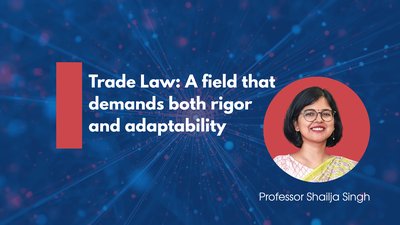
The hardest negotiations are often not across the table, they’re behind the table.
— Professor Shailja Singh