24 Jun 2026
Trade Agreements and Democratic Governance: New Evidence from the TRADEM Dataset
Modern trade agreements do not just govern trade.
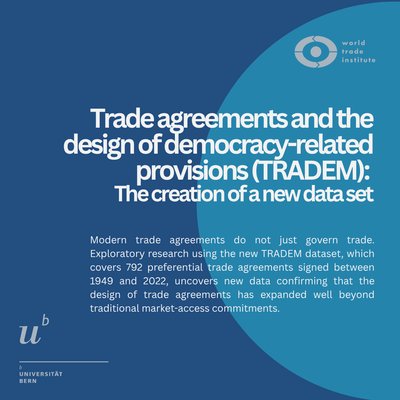
Exploratory research using the new TRADEM dataset, which covers 792 preferential trade agreements signed between 1949 and 2022, uncovers new data confirming that the design of trade agreements has expanded well beyond traditional market-access commitments. This research indicates that the design of contemporary trade agreements increasingly addresses democracy-related issues alongside trade concerns, reflecting a broader evolution in how international economic cooperation is structured.
About the dataset:
- Covers 792 preferential trade agreements signed between 1949 and 2022
- Identifies democracy-related provisions across six categories
- Measures both the presence and comprehensiveness of democracy-related commitments, combining detailed manual coding with machine-learning techniques
- See the dataset here
Democracy-related Provisions Are Becoming More Common Over Time
Modern trade agreements increasingly include provisions related to:
- Democracy-specific provisions
- General objectives listed in the preamble
- Transparency in policymaking and implementation
- Stakeholder and civil society participation
- Protection of individual rights
- Governments' ability to regulate in pursuit of public policy objectives
These provisions sit alongside traditional commitments on market access, tariffs, and trade liberalization. The data indicates that contemporary trade agreements increasingly address governance-related issues alongside trade, reflecting a broader evolution in the structure of international economic cooperation within preferential trade agreements.
“This dataset provides new and important avenues for future research: understanding why these provisions are adopted, how they spread across agreements and regions, and whether they influence governance outcomes, democratic resilience, or political institutions in practice.” – Manfred Elsig, Managing Director of the World Trade Institute at the University of Bern
Explicit democracy-promotion provisions remain relatively rare
The strongest growth over the past three decades has occurred in:
- Transparency provisions
- Stakeholder participation mechanisms
- Individual rights protections
By contrast, explicit democracy-promotion provisions remain relatively rare.
“It could be that democracy-promotion provisions require a higher threshold to be met, and most countries that sign the trade agreements do not have the political capital to meet those demands yet. Democratic consolidation rarely happens overnight; this process tends to unfold slowly and only when genuine ambition exists. Policymakers should keep that in mind.” – Dr. Kirthana Ganeson, post-doctoral researcher at the World Trade Institute at the University of Bern.
Democracies Tend to Negotiate More Democracy-Rich Agreements
Trade agreements involving a higher proportion of democratic countries are more likely to contain broader and deeper democracy-related provisions than agreements involving primarily non-democratic countries.
The authors find that trade agreements scoring higher on the TRADEM index are more likely to involve democratic members, whereas agreements with few or no democracy-related provisions are more common among non-democratic members.
Regional Differences Matter
Europe leads in the inclusion of democracy-related provisions in trade agreements, while Latin America has also emerged as a significant adopter. Although regional approaches vary, the research finds growing incorporation of democracy-related provisions across Asia and Africa and evidence of increasing convergence in recent years.
Why Studying Trade Agreements Matters
Debates about trade policy often focus on economic outcomes such as growth, investment, and market access. This novel research highlights a broader trend: trade agreements increasingly incorporate rules related to how governments make, implement, and communicate policy decisions. The findings suggest that modern trade agreements are evolving beyond traditional commercial concerns to include provisions connected to governance processes, rights protections, transparency, participation, and regulatory autonomy. Trade agreements are not only about reducing barriers to commerce. Increasingly, they also contain provisions that shape transparency, participation, rights protections, and the policy space governments retain to pursue public objectives.
The TRADEM dataset provides the most comprehensive evidence to date on how these governance-related provisions have developed across the global trade system.
Read the full article here.
The authors gratefully acknowledge support from the Swiss National Science Foundation SNSF, which made this research possible.
About the Researchers
Learn more about the researchers that created the TRADEM dataset, the most comprehensive database to date on democracy-related provisions in trade agreements.
Manfred Elsig is a professor of International Relations and the Managing Director at the World Trade Institute, University of Bern, Switzerland. His research focuses on international trade policy, trade agreements, global economic governance, and the political economy of international institutions.
Dr. Kirthana Ganeson is a postdoctoral researcher at the World Trade Institute at the University of Bern and contributed to the development and analysis of the TRADEM dataset. Her research focuses on norm diffusion in international political economy, with particular emphasis on how international organizations and trade influence democracy, development, and governance.
Andrew Lugg is an assistant professor with the Department of Political Science at the University of Nevada, Las Vegas (UNLV), United States. His research focuses on international political economy, trade agreements, democracy, and comparative political institutions.
Marine Roux is a Postdoctoral Fellow at the Department of Political Science at Stockholm University, Sweden. Her research examines the diffusion of democratic norms in trade policy and the conditions under which democracies and autocracies engage in international treaty cooperation.