3 Sep 2026
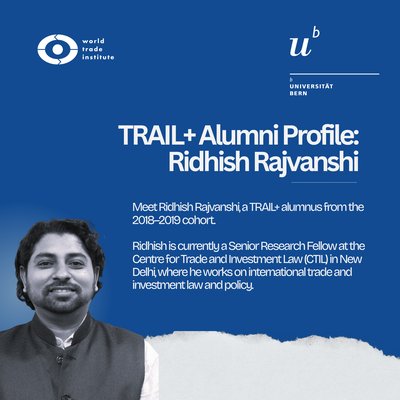
TRAIL+ Alumni Profile: Ridhish Rajvanshi
Meet Ridhish Rajvanshi, a TRAIL+ alumnus from the 2018–2019 cohort. Ridhish is currently a Senior Research Fellow at the Centre for Trade and Investment Law (CTIL) in New Delhi, where he works on international trade and investment law and policy.
He is also an Associate with Rajkumar and Associates - Legal Consultants, Jaipur advising businesses on compliance and import-export matters. Before joining CTIL, he was a Consultant with the Trade Policy Hub at LSE Consulting, London, a trainee at a private law firm in Brussels focusing on EU trade remedies and, a trainee at the Universal Postal Union in Bern, Switzerland. He holds an LL.M. in International Trade and Investment Law with a Diploma of Advanced Studies in International and Economic Law (TRAIL+) from the World Trade Institute at the University of Bern.
What first sparked your interest in international trade law?
I decided quite early that I wanted to pursue law. During my second year at Symbiosis Law School in Pune, I participated in a moot court competition that included elements of competition law, arbitration, and international trade law. I decided to take on the trade law component.
At the time, we did not have a faculty member specifically teaching trade law, so I started learning about it on my own. I remember reading books by Professor Peter Van den Bossche and Professor Michael Hahn in preparation for the competition. I became very fascinated by the subject and thought, “Maybe this is something I’ll pursue.”
What attracted me was the interdisciplinary nature of trade law. I was interested in economics, international relations, how countries interact with one another, and how international agreements are interpreted. Trade law brought all of these interests together.
During my penultimate year of law school, I attended WTO@20 Conference 2017 in New Delhi, where I met Professor Peter Van den Bossche. We discussed developments in trade law and my earlier experience with his books, and he told me more about the World Trade Institute. This initiated my journey towards finding the right program to pursue a master’s degree in this field.
Why did you decide to join the WTI?
I was looking specifically for a master’s degree specializing in trade and investment law. I researched programs in Europe, the United States, Singapore, and Australia, but the WTI stood out.
For anyone wanting to build a career in international trade, the global community is relatively small. Few institutions provide a specialized LL.M. in International Trade; most universities offer a general LL.M. where trade is merely an elective specialization.
Among the few options available, the WTI caught my eye for multiple reasons. What I liked about TRAIL+ was that it was a legal master’s degree with a specific focus on international trade and investment law. I also wanted to be in Switzerland because of its proximity to Geneva and the WTO. Additionally, the faculty and guest lecturers associated with WTI are leading practitioners in the field.
Before making my decision, I reached out to several WTI alumni on LinkedIn. Many were generous enough to speak with me for 30 to 60 minutes about their experiences. Those conversations gave me a much clearer sense of what studying at the WTI would actually be like.
The faculty and curriculum were important, but so was the community surrounding the program. It was clear that the WTI brought together people who were deeply involved in international trade, economics and investment law.
Fortunately, my application was successful on the first attempt (applied towards the end of my final year of law school) and I was awarded the Director’s Scholarship, which granted a partial waiver on my tuition fees. Sometimes you instantly know when you apply and secure a seat that it is exactly where you belong.
What stands out as having been a particularly positive experience at the WTI?
It is difficult to choose a single favorite course because I found the entire program engaging. I completed 60 credits in my first semester, which is quite unusual, but when you enjoy the subjects, you make the time.
The faculty members are exceptional at ensuring everyone has a solid grasp of core concepts and fundamentals.
One of the things I appreciated most was the combination of required reading and the practical experience of the faculty. You would complete the readings before class and bring your questions to lecture. The professors had 15, 20, or even 25 years of experience in the field, so they brought practical perspectives that you simply could not find in a textbook.
The diversity of the cohort was equally valuable. We had recent graduates as well as professionals with 10 to 20 years of experience in government or the private sector. Everyone brought a unique perspective.
I recall the negotiations class with Professor Victor Prado, where students from India, Brazil, and other countries were deliberating different positions. At one point he remarked that it felt just like being in a WTO negotiation room. That kind of peer-to-peer learning was significant and invaluable. You were learning not only from the faculty, but also from the people sitting next to you.
I also appreciated the opportunity to take courses outside of the WTI at the University of Bern. For example, Professor Felix Addor’s negotiations course featured simulation exercises alongside students from various disciplines across University of Bern. I even attended a few lectures at the University of Bern outside my field, including a theology class. If you are willing to explore, there is an enormous amount to learn.
Beyond academia, the WTI facilitates practical learning and networking through field trips to the WTO, UN, and other international bodies alongside opportunities to attend conferences, events, panel discussions etc. in Geneva and even other cities in Europe. The level of exposure one avails is unmatchable.
How did the WTI prepare you for your career?
The WTI was instrumental in making students aware of professional opportunities. During my second semester, I began applying for internships and jobs. Through opportunities shared by the WTI and support from the faculty, I secured positions including one at a Brussels-based law firm and later at the Universal Postal Union.
My career path after the WTI was not completely straightforward. Due to COVID-19, I moved back to India and later joined the Centre for Trade and Investment Law. What I initially thought would be a short-term position has become a significant chapter of my career. The work has given me hands-on experience with issues I might not have encountered for years if I had followed a different career path.
Today, at CTIL, I handle international trade and investment matters, including research, legal and policy advice, publications, and stakeholder engagement. CTIL is a research and advisory think-tank established by the Ministry of Commerce and Industry, Government of India at the Indian Institute of Foreign Trade, New Delhi to help build India’s capacity in trade and investment matters and advise the government on these issues. At CTIL, we support government-to-government (G2G) negotiations and policy formulation across critical trade domains.
What advice would you give to current TRAIL+ students?
My first piece of advice is to start planning your career early. When I began applying for internships and jobs, I realized that many applicants had already been applying for six months. The competition is strong, so understanding the application process and timeline is critical. So, I say, start early.
I also encourage students to build on their language and writing skills. If you intend to work in European or international organizations, having a strong working knowledge of French, German, Spanish or Arabic can make a difference, set you apart. I had B1/B2-level French, but found that several organizations required C1 or C2 proficiency.
Finally, make the most of the network around you.
The WTI brings together people with diverse professional and national backgrounds, and that is one of its greatest strengths. Take full advantage of peer learning, attend interdisciplinary courses, and engage with people who approach a problem from a completely different perspective. My friends in Switzerland, are all from diverse backgrounds and non-law. It is extraordinary to observe your own growth and personal development.
What are you currently working on?
My work at CTIL focuses on international trade and investment law and policy, bridging the gap between policy formulation, negotiations and legal implementation. My core advisory areas include FTA strategy and negotiations, digital economy regulation and rules of origin. I also have a proven track record advising sovereign governments and private entities on compliance, customs and trade facilitations, export promotion, supply chain resilience and trade remedial investigations.
One of our objectives at CTIL is also to contribute to South-South trade policy dialogue and broader international discussions on trade and development.
Recently, I have been involved in international outreach surrounding the WTO Public Forum. Our research examines how services contribute to development, income generation, and job creation, including through sustainable tourism, and how these sectors create opportunities for youth and women. Looking back, it is rewarding to see how closely my current work aligns with the interests that first drew me to the WTI: international trade, policy, law, and the way countries interact within the global trading system.
Further info
See Ridhish Rajvanshi's bio here
Learning can come from anywhere. It need not come only from your books or from the faculty. It comes from peer-to-peer learning, day-to-day engagements, and your interaction with other people.
— Ridhish Rajvanshi