27 Oct 2026
Trade Remedies in Changing Times: Five Questions with Edwin Vermulst
As geopolitical tensions reshape international trade, anti-dumping and safeguard measures are becoming increasingly important tools for governments seeking to protect domestic industries. But how do these instruments work in practice, and why does understanding their legal and economic complexities matter more than ever?
At the intersection of WTO law, industrial policy, domestic industry protection, and commercial strategy, trade remedies are taking on renewed significance.
We spoke with Edwin Vermulst, an expert in international trade law and lecturer at the World Trade Institute (WTI), about the growing importance of trade remedies, emerging developments in their application, and why professionals working in international trade should deepen their understanding of these instruments.
As Vermulst observes, “May you live in interesting times” has never been truer.
1. Why are trade remedies becoming increasingly important in today's trading environment?
With governments responding to changing trade patterns, geopolitical developments, and growing pressure on domestic industries, what role are anti-dumping and safeguard measures playing in trade policy?
Edwin Vermulst: Anti-dumping and safeguard measures are legally authorized tools to protect domestic industries from injurious imports. As a result of increased international political and economic tensions, many WTO members are making greater use of these instruments.
2. What is the biggest misconception about anti-dumping measures?
Anti-dumping duties are often understood simply as tariffs on unfairly priced imports. What do trade professionals need to understand about the legal and economic analysis behind these measures?
Edwin Vermulst: The determinations of dumping and resulting injury are much more complex than they may seem at first sight, as they involve a mixture of legal, economic, and accounting issues.
If the stakes are high enough, anti-dumping measures often give rise to WTO dispute settlement proceedings. In fact, more WTO disputes have concerned the Anti-Dumping Agreement than any other WTO Agreement.
3. How are geopolitical tensions and changing supply chains affecting the use of trade remedies?
As governments pursue greater economic security, supply-chain resilience, and domestic production, are anti-dumping and safeguard measures becoming more strategically significant?
Edwin Vermulst: Absolutely. These instruments provide legally authorized means to limit imports from specific countries and may therefore change trade flows and support such policies.
4. What developments in anti-dumping and safeguards should trade professionals be watching?
Looking ahead, which legal and policy developments are likely to have the greatest impact on investigating authorities, exporters, domestic producers, and their advisers?
Edwin Vermulst: As a result of geopolitical and geoeconomic developments, administering authorities are under great pressure to protect their domestic industries. This is resulting in creative, if not aggressive, unilateral interpretations of the WTO Anti-Dumping and Safeguard Agreements.
Multi-interpretable concepts such as “significant distortions” and “particular market situations” are gaining ground.
5. Why is now a good time to deepen expertise in trade remedies?
With trade remedies playing an increasingly prominent role in international trade policy, why is practical knowledge of anti-dumping and safeguard investigations particularly valuable?
Edwin Vermulst: With the increased recourse to anti-dumping and safeguard measures worldwide, knowledge about how these laws actually are, or can be, applied in practice is essential.
The devil is in the details, and therefore knowledge of the details is key to a proper understanding of the power of these instruments.
From Trade Policy to Practice: Deepen Your Expertise at the WTI Academy
Understanding the rules governing anti-dumping and safeguards is increasingly important for professionals working at the intersection of international trade law, government policy, and commercial strategy.
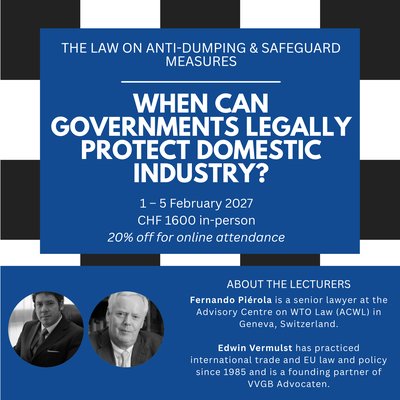
The WTI Academy's Anti-Dumping and Safeguards course, taught by Edwin Vermulst and Fernando Piérola, offers participants an opportunity to examine these instruments and develop a deeper understanding of their legal and practical application.
Course details
-
Dates: 1–5 February 2027
-
Location: World Trade Institute, University of Bern, or online
-
Credits: 3 ECTS
-
Lecturers: Edwin Vermulst and Fernando Piérola
Explore the WTI Academy and learn how specialized training can strengthen your expertise in international trade law and policy.
Learn more: https://www.wti.org/study/wti-academy/