28 Oct 2026
Subsidies, Industrial Policy and the Future of WTO Rules: Five Questions with James Flett
As governments increasingly turn to subsidies to support strategic industries, economic security and the green transition, understanding the WTO rules governing state support is becoming more important than ever. But how can governments distinguish between "good" and "bad" subsidies, and what challenges arise when applying these rules in practice?
At the intersection of WTO law, industrial policy, strategic competition, and environmental objectives, subsidies and countervailing measures are taking on renewed significance.
We spoke with James Flett, lecturer at the World Trade Institute (WTI), about the growing importance of subsidies in international trade policy, the challenges of applying WTO rules, and why trade professionals should deepen their understanding of these instruments.
1. Why have subsidies moved to the center of international trade policy?
Governments are increasingly using subsidies to support strategic industries, technological development, the green transition, and economic security. What does this mean for the international trading system?
James Flett: Governments typically frame and shape markets through fiscal measures, regulatory measures and/or subsidies.
The basic rule for fiscal and regulatory measures is that they should be non-discriminatory, unless discrimination is justified as necessary to achieve a legitimate policy objective. Subsidies law is carved out of this rule because it is well understood that subsidies may be granted only to domestic firms.
That leaves the question of how to distinguish between "good" and "bad" subsidies.
Leaving aside prohibited export and import substitution subsidies, that depends on whether or not a subsidy causes injury or adverse effects, in terms of price and volume, to a trading partner.
On the one hand, the increased use of subsidies correlates to more influence for domestic stakeholders, unilateralism (including countervailing duties), subsidies competition and inefficiency. On the other hand, subsidies permit governments to pursue legitimate policy objectives, such as protection of the environment, particularly when progress at the international level is frustrated.
The key tool for distinguishing between "good" and "bad" subsidies is thus causation. But this is a somewhat nebulous concept that is not particularly amenable to objective assessment, even after extensive and expensive litigation at the WTO.
2. When does government support become a subsidy under WTO law—and when does it become problematic?
Terms such as "industrial subsidies" and "state support" are widely used in policy debates. What legal distinctions do practitioners need to understand when assessing whether government intervention falls within WTO subsidy disciplines?
James Flett: The SCM Agreement distinguishes between subsidies and other government action: a subsidy must involve a financial contribution and confer a benefit and will only be actionable if specific.
The SCM Agreement contains detailed rules tracing the parameters of these concepts.
A subsidy will only become problematic if it is a prohibited export or import substitution subsidy, or if it causes adverse effects to the interests of a trading partner.
3. How are industrial policy and geopolitical competition testing existing WTO subsidy rules?
From clean technologies and semiconductors to strategic manufacturing, governments are intervening more actively in markets. Are the existing rules equipped to address these developments?
James Flett: Whilst increasing the use of subsidies, governments generally can and do avoid prohibited export or import substitution subsidies.
Distinguishing between "good" and "bad" subsidies then depends on the concept of causation, which is relatively uncertain, subjective and difficult to apply in practice.
Governments may refrain from seeking review of the subsidies of other members when they themselves are granting similar subsidies.
And the rules regarding "non-subsidised like products", which address the situation in which two or more members grant subsidies at the same time, remain obscure, poorly understood and difficult to apply.
4. What should trade professionals be watching in the debate over subsidy reform?
Where are the most significant tensions in the existing SCM framework, and what kinds of reforms could reshape how governments design and challenge subsidy programs?
James Flett: Members tend to view their own subsidies as "good" and the subsidies of others as "bad". They seek to frame the rules in a manner that they perceive serves their own interests, making agreement difficult.
They seek to add subsidies they perceive as "bad" to the prohibited category without understanding that it is defined by reference to the existence of a market partitioning contingency, not by reference to what the subsidy is given for.
This makes agreement difficult and indicates that the existing rules are unlikely to change in the foreseeable future. This in turn tends towards increased use of countervailing duties.
Because the concept of causation is so nebulous it may not provide an effective tool for resolving such disagreements, even after extensive and expensive litigation.
5. Why is now a good time to deepen expertise in subsidies and countervailing measures?
With subsidies playing an increasingly prominent role in international trade policy, why is practical knowledge of WTO subsidy disciplines particularly valuable for governments, legal practitioners, international organizations, and businesses?
James Flett: Because the current geopolitical and economic situation tends to push governments towards unilateral measures such as subsidies, the regulation of which is problematic, there is a significant additional threat to the security and predictability that businesses seek when engaging in international trade.
But this does not mean that governments should abandon and disregard subsidies disciplines in favour of mercantilist objectives.
Governments still have an interest in complying with the existing rules to the greatest extent possible, also in the interests of their own citizens and taxpayers, for whom subsidies are not necessarily efficient or effective.
This can usually be done if, from the outset of the selection and design of a measure, international subsidies law is appropriately taken into account.
From Industrial Policy to Practice: Deepen Your Expertise at the WTI Academy
Understanding the rules governing subsidies and countervailing measures is increasingly important for professionals working at the intersection of international trade law, government policy, and commercial strategy.
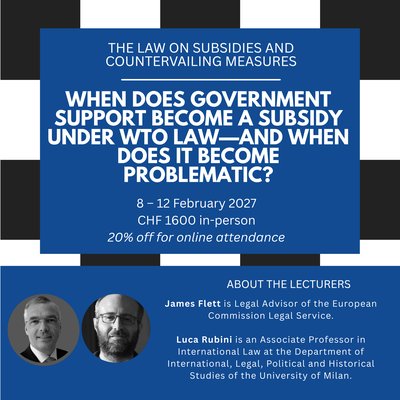
The WTI Academy's Law on Subsidies and Countervailing Measures course, taught by James Flett and Luca Rubini, offers participants an opportunity to examine the WTO rules governing subsidies and develop a deeper understanding of their legal and practical application.
Course details
-
Dates: 8–12 February 2027
-
Location: World Trade Institute, University of Bern, or online
-
Credits: 3 ECTS
-
Lecturers: James Flett and Luca Rubini
Explore the WTI Academy and learn how specialized training can strengthen your expertise in international trade law and policy.
Learn more: https://www.wti.org/study/wti-academy/