

24 Nov 2026
Understanding trade and development through history: Meet Nicolas Hafner
In Search of a Geneva Consensus at the World Trade Institute
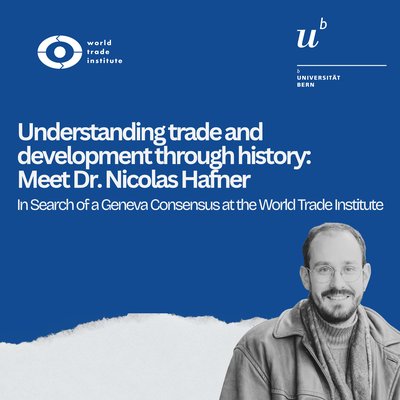
Dr. Nicolas Hafner joins the World Trade Institute (WTI) as a postdoctoral researcher, bringing a historian’s perspective to its interdisciplinary research. Working with Prof. Dr. Manfred Elsig, Managing Director of the WTI and Professor of International Relations, and Dr. Kirthana Ganeson as part of project In Search of a Geneva Consensus, he will explore how ideas about trade and development have evolved in a host of Geneva-based International Organizations—and what historical context can reveal about global economic governance.
What will you be working on at the WTI?
I am part of a research project examining how discussions about trade and development have evolved at the United Nations Conference on Trade and Development (UNCTAD), the General Agreement on Tariffs and Trade (GATT) and the World Trade Organization (WTO) from the 1960s until today. The project brings together different methods, including the analysis of institutional documents and member countries’ statements using large language models.
My contributions are both historical and qualitative in nature. Through archival research and, where appropriate, oral history interviews, I will help investigate changes in these discussions: what happened, why positions shifted, and how the people involved understood the issues at the time. Archival work and interviews were also central to my PhD research, so this is a special skillset I bring to the WTI.
What are you most looking forward to exploring?
I am particularly interested in identifying something that is difficult to explain -- and then investigating it in depth. If a country changes its position on the relationship between trade and development, for example, what lies behind that change? What can we learn from the historical context that might not be immediately visible in the broader data?
The interdisciplinary exchange is another exciting part of the project. We come from different academic backgrounds, which means we sometimes approach the same question in very different ways. Working through those differences can open up new questions and challenge assumptions in a way that adds richness to the research.
How does your background as a historian shape your approach?
One question that occupied much of my PhD was what “development” meant to different historical actors. It is easy to assume that development means economic growth, but the people I studied did not necessarily understand it that way.
When we examine debates about whether trade supports development, we should ask what the people involved meant by development in the first place.
Broad theoretical categories can help identify patterns, but historical actors’ views do not always fit neatly into them. I am interested in exploring those complexities and considering how they might enrich the project’s analytical framework.
What can historical research contribute to the study of global economic governance?
Historical research helps us understand decisions in the circumstances in which they were made. People in the past did not know how events would unfold. They worked with imperfect information and made decisions that sometimes had lasting consequences.
To give you an example from the research for my MA thesis: There has been a growing interest in the history of international investment law, given the surge in Investor-State Dispute Settlement (ISDS) claims, a system that allows private foreign investors to sue a sovereign host government through binding international arbitration. Today there are over 2800 bilateral investment treaties, and most include this mechanism. Thanks to historical research, we know that much of the meta language on how investments should be governed comes from the 1950s, and that private actors were involved from the start. As colonies gained independence, companies feared having their investments seized and sought to protect them through various legal schemes. Wording developed then now applies to a very different world, and it is used to challenge things its authors never imagined, such as climate or health policies. Historians thus help explain how we got here. And though they won’t tell us what the rules should be today, they push us to ask questions, including whether rules written for one world still fit another.
I hope to bring that attention to context into the project and into conversations with colleagues across the WTI.
How would you like to collaborate across disciplines?
I would welcome opportunities for sustained discussion about how our disciplines approach research. Alongside exchanging feedback on individual papers, there is value in explicitly discussing our methods and ways of asking questions, and what assumptions might inform either.
A dedicated workshop or discussion format could provide space for that exchange. During a PhD, much of the conversation takes place among specialists in the same field. Joining an interdisciplinary institute offers an opportunity to engage with work happening beyond those boundaries.
How might WTI students engage with your work?
Teaching would be one way to bring these perspectives into conversation. I would like to offer a course examining the historical evolution of the international system and global governance, with a focus on economic relations and inequality. I would look forward to discussing these questions with students—and to having my own perspectives challenged by them.
Above all, I hope students take away the importance of context and of questioning what we take for granted. Understanding how people saw the world at a particular moment can help us recognize that the ideas and institutions familiar to us today have histories of their own.
People in the past did not know how events would unfold. They worked with imperfect information and made decisions that sometimes had lasting consequences.
— Dr. Nicolas Hafner