Brown Bag Seminar
27 Oct 2026
,
12:15
-
13:15
| Download
Calendar Event (ICS)
Auditorium Anna Nussbaum, World Trade Institute,
Hallerstrasse 6, Bern, Switzerland & online
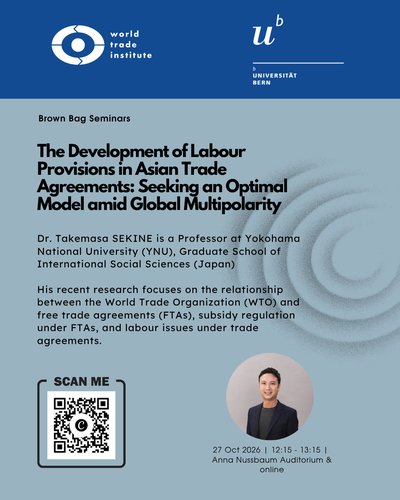
The Development of Labour Provisions in Asian Trade Agreements: Seeking an Optimal Model amid Global Multipolarity
The inclusion of labour provisions in trade agreements concluded by Asian countries is expanding rapidly. While some labour provisions were present in earlier trade frameworks—such as the Generalized System of Preferences (GSP) and bilateral agreements—this trend has become markedly more pronounced since the Trans-Pacific Partnership (TPP) Agreement. Negotiations for the Indo-Pacific Economic Framework (IPEF) under the Biden administration and the conclusions of Reciprocal Trade Agreements (ARTs) under the second Trump administration also align with this trajectory. Although Asians earlier were historically reluctant to adopt labour provisions, they have softened their stance in recent years in response to strong demands from the United States and the European Union. Indeed, they are now beginning to accept even the most advanced types of labour provisions. Against this backdrop, this presentation examines key provisions in notable trade agreements to clarify the characteristics and impact of the labour clauses currently taking root in the Asian region. The legitimacy of labour provisions can be grounded in considerations such as fairness, the avoidance of a "race-to-the-bottom," consumer citizenship, and the protection of human rights. To date, US trade agreements have focused primarily on fairness and preventing a race-to-the-bottom. Given the significant influence the US exerts over trade agreements in the region, it can be said that agreements involving Asian countries also share a similar character, despite some variations. Furthermore, recent labour provisions have become linked to issues of economic security, suggesting they could have an impact that extends far beyond the scope of mere labour-related matters.
Dr. Takemasa SEKINE is a Professor at Yokohama National University (YNU), Graduate School of International Social Sciences (Japan). He received his legal education at Keio University, Japan (Ph.D. and LL.M). He was a board member of the Government Procurement Review Board (2014-2024) and an assistant director of the Research Planning Committee of the Japan Society of International Economic Law. He has also joined research projects hosted by Japanese governmental institutions, such as the Ministry of Foreign Affairs of Japan (MOFA) and the Research Institute of Economy, Trade and Industry (RIETI). His recent research focuses on the relationship between the World Trade Organization (WTO) and free trade agreements (FTAs), subsidy regulation under FTAs, and labour issues under trade agreements. He has published articles in a number of scholarly journals and books.